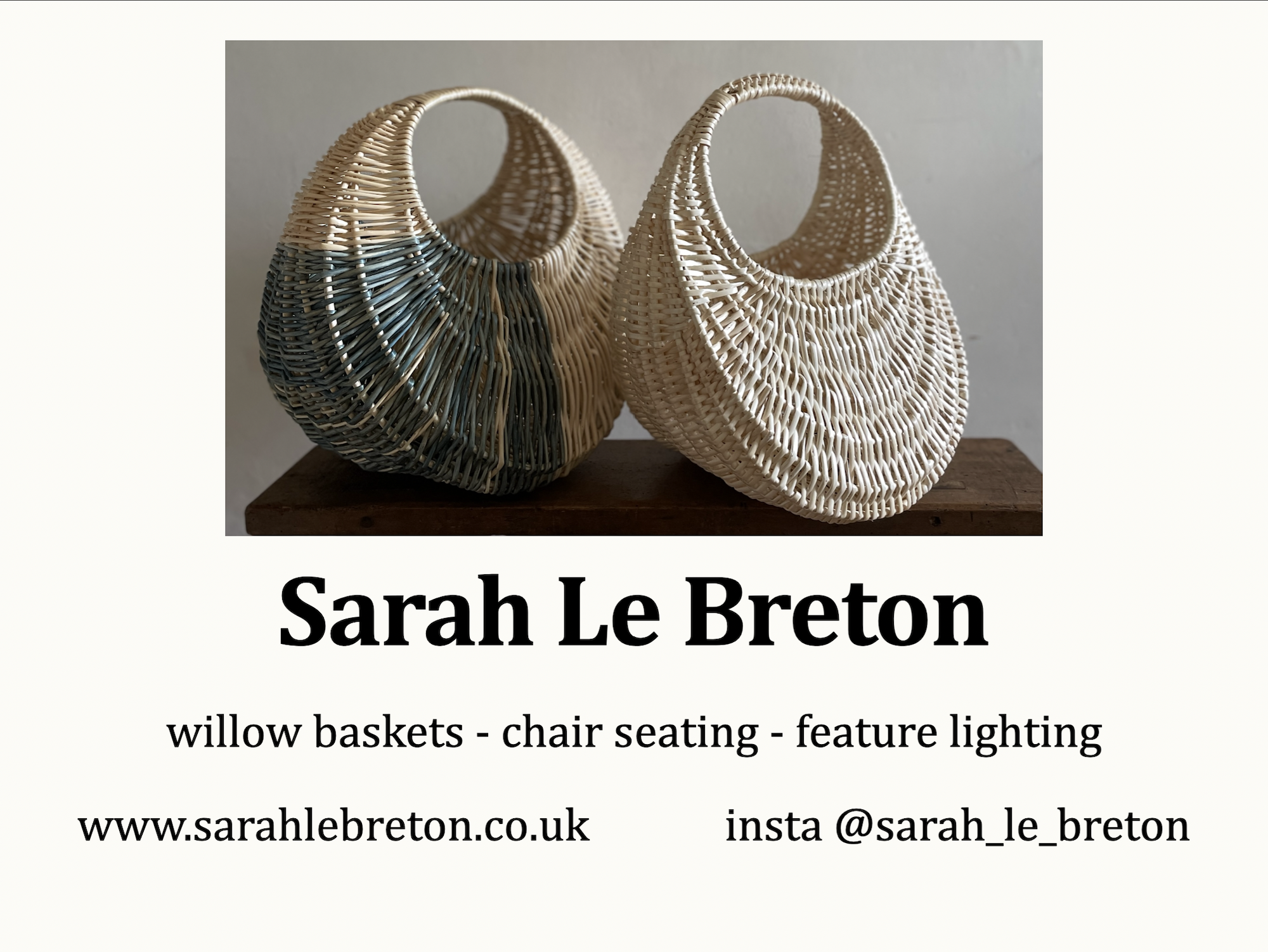
Modern Makers Presentation
At the Modern Makers & Antiquaries Event held by the Society of Antiquaries on the 22nd October ‘25 I gave a presentation about what it is to be a modern maker and my experience of being this year’s Maker in Residence at Kelmscott Manor, (the home of William Morris in Oxfordshire). I have decided to reproduce the presentation in full below and include some of the images.
The event was afterwards described as having been a balance of collegiality and healthy debate. Celebration and activism.
I am very proud to be one of those who celebrate our heritage crafts, who is a modern maker and who is an activist. We need to fight right now for our craftspeople and to create a brighter future for our next generation.
Thank you for asking me to speak at this event. I’d like to share with you my experience of being a modern basket maker - designer - teacher. I am this year’s Maker in Residence at Kelmscott Manor.
What I Do … Making predominately in willow, but also in rush material, I focus upon hand crafting work that marries heritage basket forms, (that showcase often advanced or lesser known traditional English basketry techniques), with innovative ideas.
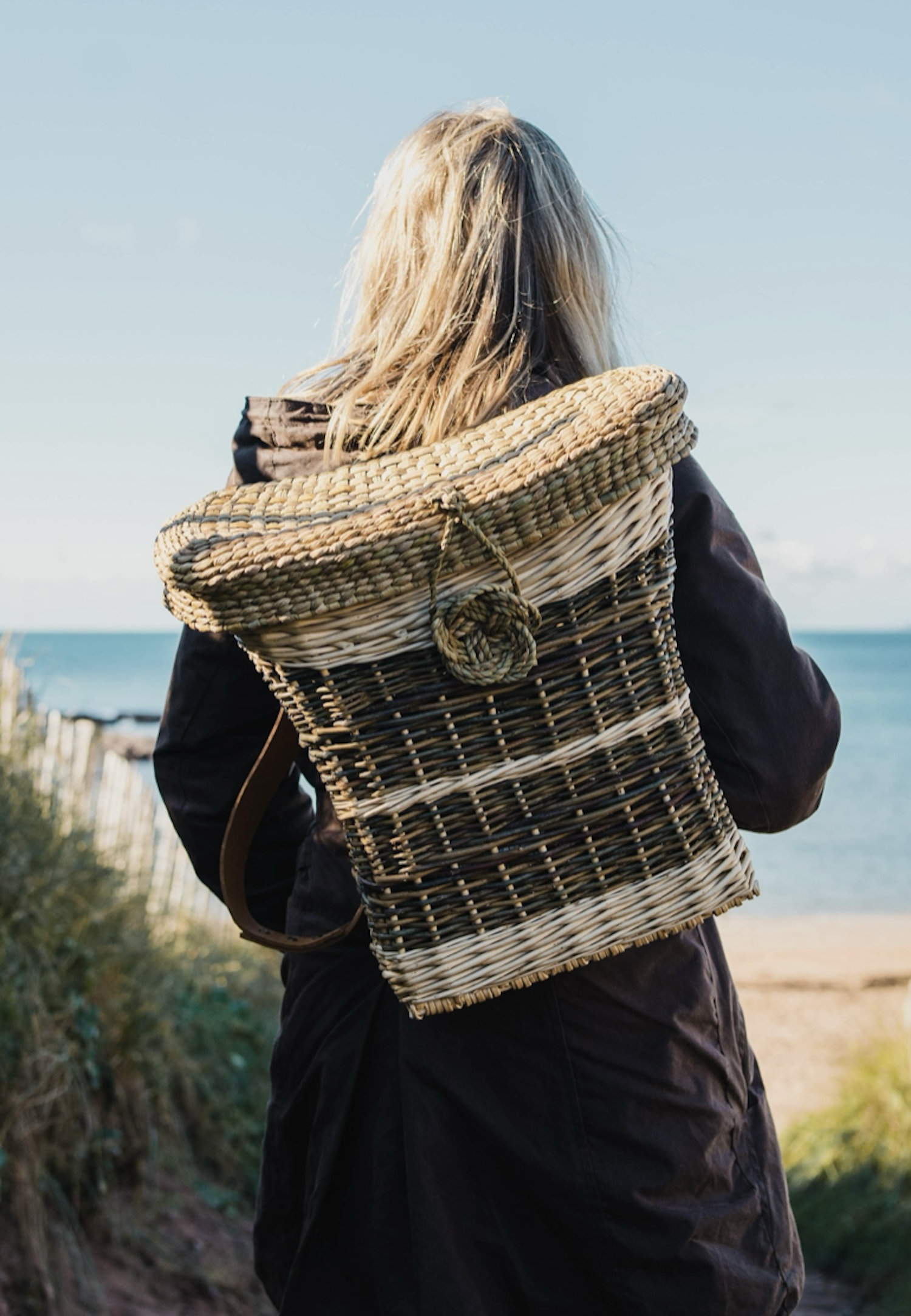
In creating baskets, backpacks, lighting features and chair seating that are perfect for modern living, my mission is to secure, evolve and create a future for basketmaking and chair seating.
I aim to highlight the beauty of natural materials and only make and teach with locally sourced materials, often harvested by myself.
I believe that the commercial led basketmaking methodology and the traditional English techniques and the skill set that I have been fortunate enough to learn are vital to the continuation of my heritage craft form. This is hugely influential for me.
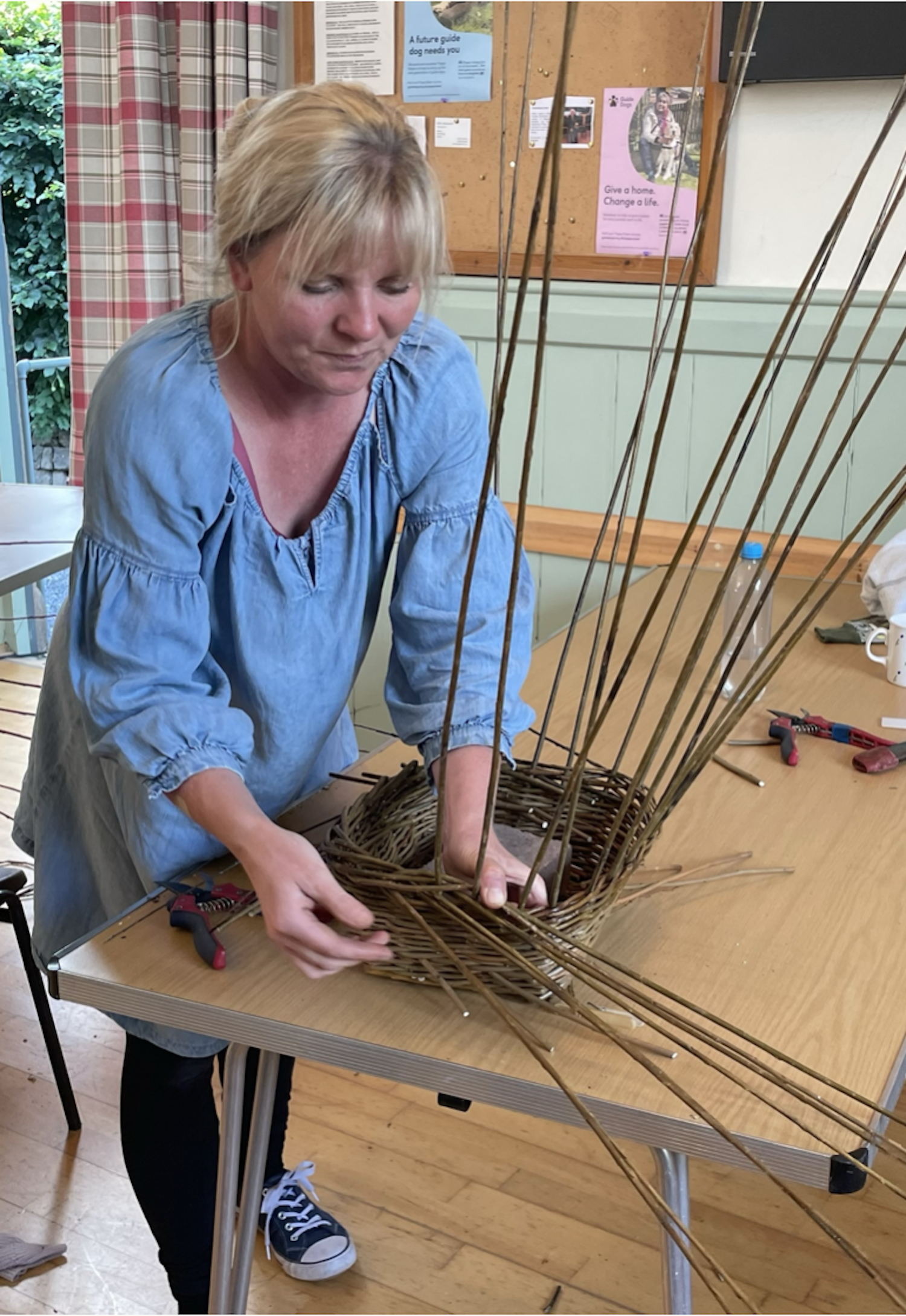
Both in the baskets that I design and make, and in my teaching, I continually focus upon trying to find routes to enable the highly skilled and currently endangered techniques in basketry, and it’s accompanying knowledge, to be passed from craftsperson to craftsperson, thereby reaching future generations.
To give you a more immediate understanding behind what I do and why, I’ll explain the importance through my teaching. Over a decade ago I established my freelance teaching business creating 1 and 2 day Willow Workshops for groups of beginner and intermediate weavers. It is important to me that I design all the baskets that I teach, each created for a specific reason or function. Often so that I can impart and promote certain techniques or help and hone lesser taught English basketry knowledge, such as how to make round and oval underfoot tied slath bases or create a Somerset Apple Picker basket handle that will never fall out.
During every workshop I make sure to talk about both our basketry heritage and our current UK commercial willow growing and basketmaking industry. I address the main barriers to accessing my craft form. This is done by advising on how to harvest and prepare willow, what tools to buy, and I demonstrate how to use them safely. I also always mention top UK basketmakers, attributing the techniques and tips that I have learnt from them.

At the beginning of every workshop we play, making a simple willow hoop whilst I give tips on how to tune in to the material. This is actually a brilliant method to help everyone connect with their willow, resulting in them creating better baskets.
Willow’s own inherent material properties of strength and flexibility, directness and flow, engage within the act of weaving, with confidence, rhythm, motion, balance and physical exertion.
The resulting, incredibly accessible energy, this intrinsic flow, creates a direct connection to nature, to self and to those around us. I’m aways in awe of the immediacy with which this happens, that through basketmaking I can assist in this discovery for others, and in so doing create inspiration, joy, hope, renewal and self belief.
So many of us are drawn to baskets and to basketmaking, we feel the innate need as humans to make, to weave. Not only this, but basketmaking holds a great power for us humans, one that it is an honour to be a part of. For in our act of making we are taking nature, living plants, deconstructing and reconstructing them into our chosen functional and hopefully beautiful forms.
As well as prioritising my own teaching business, over the past decade I have chosen to work for clients including River Cottage, the RHS and the Somerset Rural Life Museum.
More recently I have been offering bespoke 1:1 and 2:1 tuition to intermediate basketmakers from the UK and around the world at my Devon home garden studio. Along with no modern accreditation for being a master basketmaker there is a huge gap of progressive basketry training and courses. I truly believe that as good as books, online courses and YouTube videos can be, there is no substitute for decent 1:1 tuition and that this needs to be given by master craftspeople.
In order to be both a full time basketmaker and sole household income provider I have had to dedicate a vast amount of time and energy to running all aspects of my teaching business. Unlike most craft makers, in a previous career I worked in creative business management at a university. Without the knowledge and skills that I learnt there, and continually refresh, I seriously doubt I would have survived this long.

In terms of a viable future for my heritage craft form, for there to be the next young generation of full time professional basketmakers I am incredibly concerned. Not only has creativity, making and the arts been crushed within our present education system, (I have two teenage girls who can attest to this); but our present and what looks likely to be our future welfare state impedes, if not destroys the ability of us as modern craft makers, of us as self-employed low income earners to survive.
It’s seems to be a little known fact that within the Universal Credit system the self employed have to report their finances every month and that, (after their business expenses have been deducted), have to have an income of around £1600 a month in order to be eligible for the same welfare support that an employed person on £24,000 a year, (the minimum wage at 35 hours a week), receives.
This means that I have to be earning around £34,000 a year in order to receive basic welfare support for myself and my children. It’s not possible, believe me I’ve tried. What’s worse is that each month the minimum income floor of £1600 that I or any other self employed maker or creative needs to reach in order to receive this welfare support isn’t reset to zero, our previous months deficit is included, and the chances of us ever receiving any future welfare support further decreases. Couple this with inconsistent monthly earnings, myself and many other makers in the creatives industries live in constant survival mode with little or no welfare support. We offer little or no economic value and therefore in the eyes of the government I believe we are being told we have and hold no value in our society.
Creating and making, (which I believe is a fundamental human need), is increasingly again becoming for the privileged few. Those of us who need to fight to change this, to create a future for our heritage craft forms, to make a better future for our next generation, well we are often too worn down to do so. William Morris’s words that “I do not want art for a few; any more than education for a few; or freedom for a few.”* still ring so true and whilst I, as a modern maker speak up, please listen. And please if you can act upon the ability and the influence you have, help me to create a positive change.
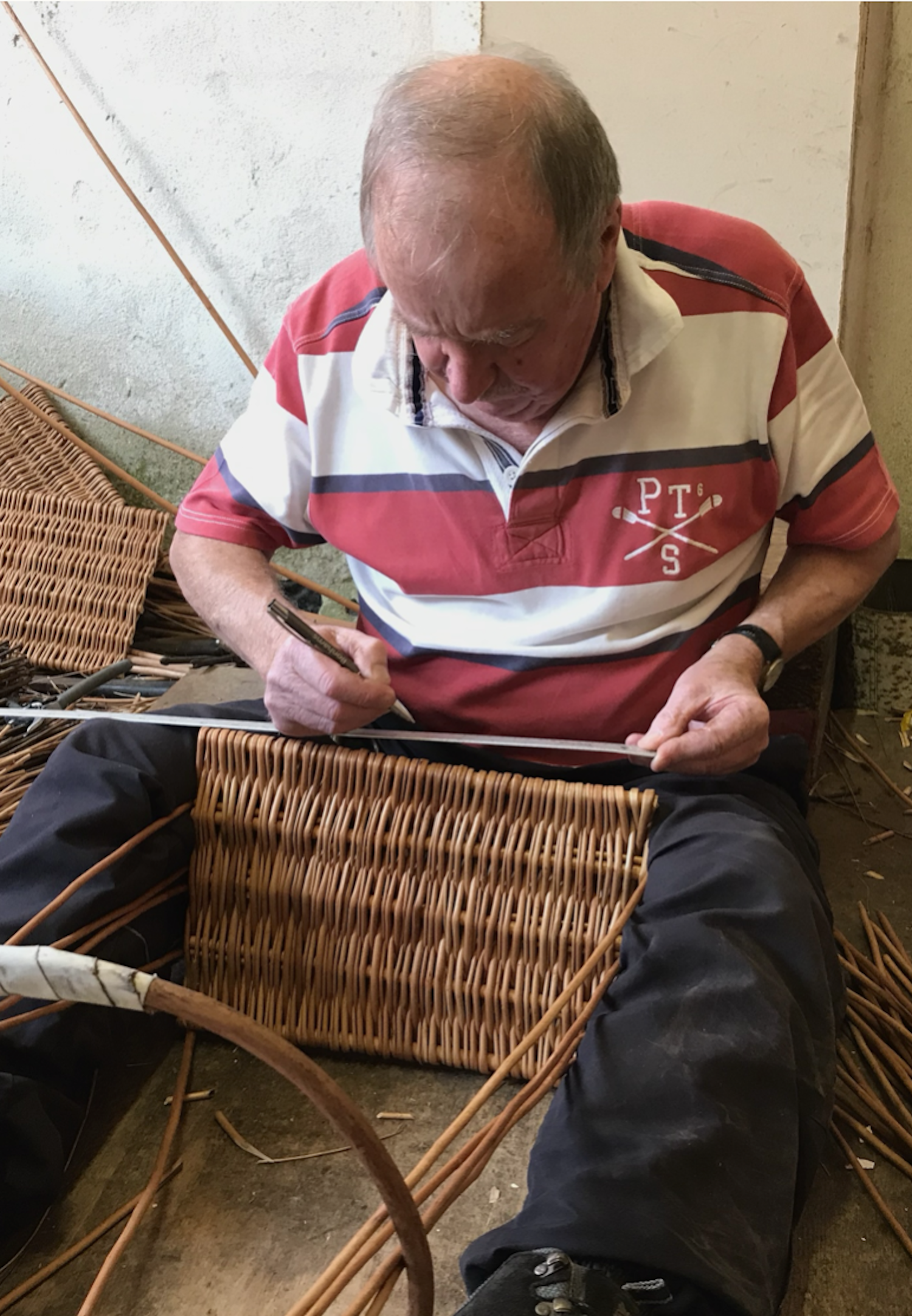
Whilst developing as a basketmaker, over the past 12 years I’ve actively sort out training from master craftspeople who are grounded in apprentice-led, commercial basketmaking. I have self funded 95% of my training, recognising early on in my basketmaking career that what I wanted training for, (learning from commercial makers), was at the time I feel less appreciated by funding bodies. In order to become the best basket maker I could be, in the time I have, I needed to, and still need to just pay and do. This has including training with one of the last dedicated commercial basketmakers on my local Somerset Levels, 4th generation maker, Eddie Barnard.
Learning the traditional way, which is known as ‘on the plank’, was an incredibly rare opportunity to take on traditional English techniques and hear stories about the willow industry and commercial basket making. Eddie used to tell me that with “practice practice practice” I would speed up and be able to make a living making baskets. If only that could be the case! Whilst learning from Eddie what I call my “granny baskets” aka functional, utilitarian traditional English buff willow baskets, I realised that I would need to create a new range of far more expensive baskets that would respect them and my time with Eddie. I was very honoured that on his retirement Eddie offered me all his basketmaking tools, including a Victorian rapping iron, a stunning brass cleave and his essential basketry knife, (which happened to be a plastic handled £3 one from B&Q!) Using tools that have made thousands of baskets, that have been held and used by multiple hands over generations, it really does make a difference.
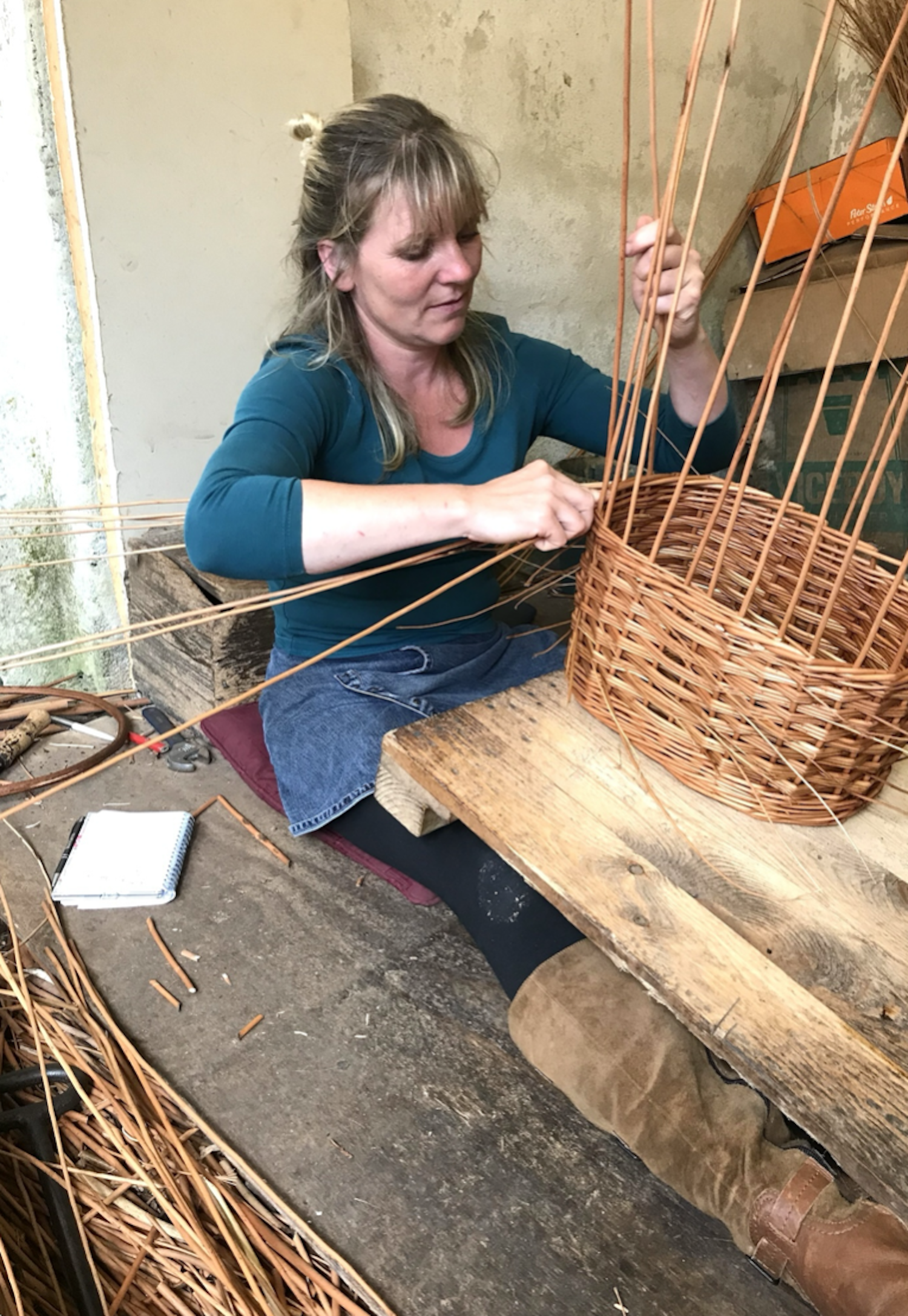
In terms of my own future training, and my being able to train others, what I do now require is funding. In recent years, as more basketmakers have emerged and realised their need to teach in order to survive, I’ve seen a shift in which those makers, without the knowledge and ability that I believe are required, are teaching too early in their careers. This has led to a dilution of skills and sometimes poor representation of our craft. They understandably cannot often afford training, but someone like myself, needs to be funded to teach them.
For myself, in terms of where I want to progress with my craft in skein work and chair seating, I need to be able to learn from the few very top makers in existence in the UK who hold this knowledge and technical ability and who are now on the brink of retirement. Further afield I need funding to be able to train with the only 2 makers in Europe with excellence in skein work in both traditional and contemporary baskets. They would enable me to gain the expertise I require to undertake and excel at rarer skein work methods (more about this later!)

My evolving collection showcases a contemporary, distinctive style whilst embodying our rich UK basket heritage. I strive, both within my product range and now emerging artistic basketry to increase the demand for beautiful artisan led work and have wholeheartedly embraced William Morris’s ambition that the maker must lead and not be led. That we as craftspeople must excel at what we make, at what we create, and innovate. I believe in the hope filled words of Morris, “You whose hands make those things that should be works of art, you must be all artists and good artists before the public at large can take real interest in such things; and when you have become so, I promise you that you shall lead the fashion; fashion shall follow your hands obediently enough.”*
When designing and building my own website last year I created an online shop. Although I do sell my work at exhibitions, through galleries and with one online retailer, this is unprofitable, (I have to think about their cut as publicity money). Instead I need to sell direct to my customers either via my website or at shows such as at Craft Festival. Due to my need to charge as higher a price as possible for my work I have never attended my local craft markets. Instead in 2023 I jumped straight into having a stand in the selling marquee at Craft Festival alongside 200 top UK craft makers.

It is my belief that until basketry work is regularly seen alongside top jewellers, glass artists, furniture makers, ceramists etc. basketmakers and their work will never be seen to have an equal value and people will not pay the prices we need.
Notably at Craft Festival, even with the resurgence of interest in heritage crafts including basketmaking, whilst all the other basketmakers are doing demonstrations outside, 3 years on I am still the only basketmaker in the selling marquees. My mission to show the value of my work, myself and my craft form continues…
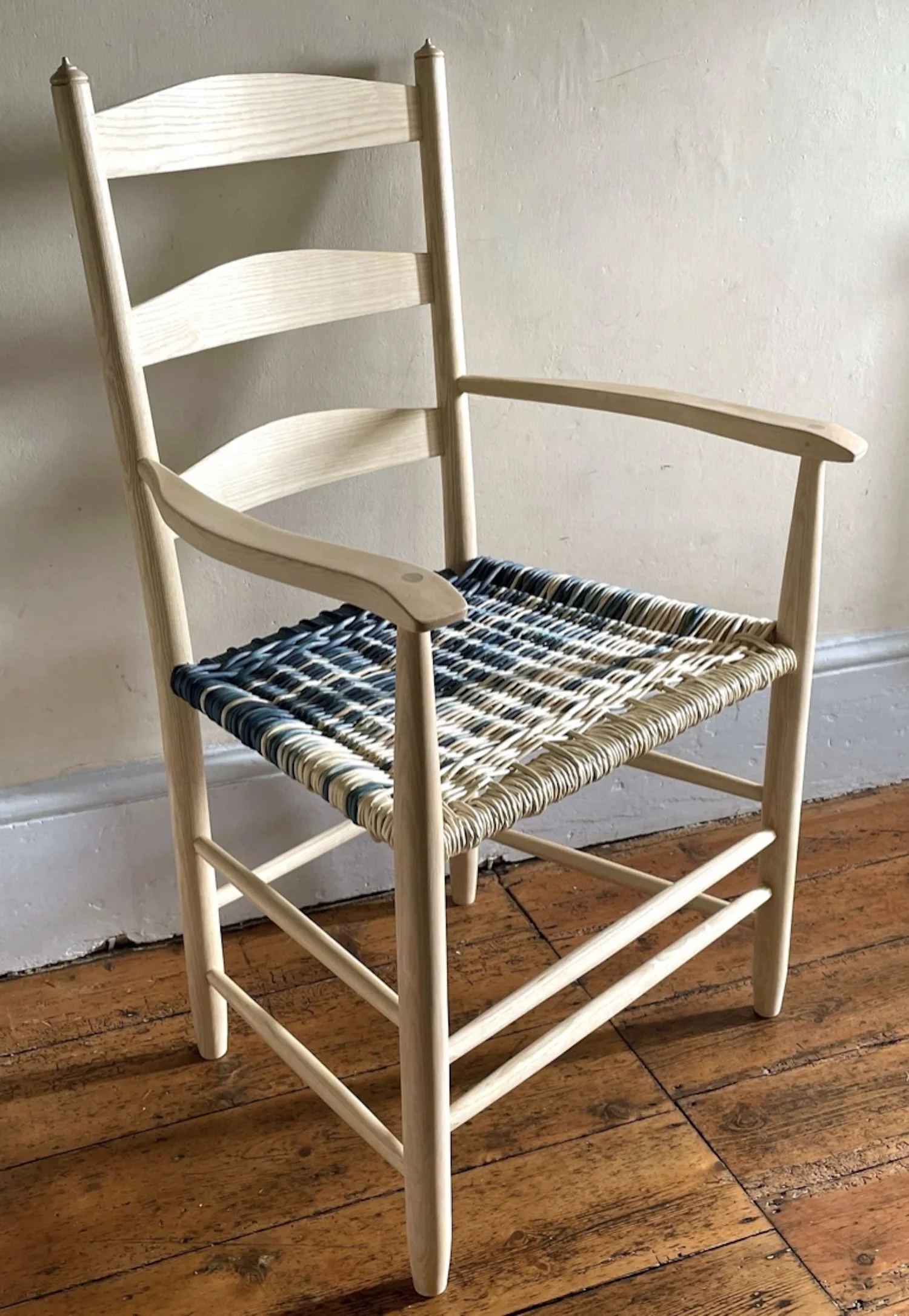
With a passion for the Arts & Crafts movement, and an understanding of the highly skilled traditional basketry techniques needed to create whole willow seating, it was natural for me to research Ernest Gimson’s willow seated chair at the Wilson Museum in Cheltenham and then choose to reinterpret his work.
The ash wood Bedales chair frame was made for me by Lawrence & Daniel Neal, father and son, 4th & 5th generation furniture makers descending from and working in the Gimson tradition. Advanced techniques including skeining, scalloming and cranking were involved in the making of the seat which also features indigo dyed white willow created using a natural vat fermentation process that I experimented with and developed.
Lawrence has also made for me a Gimson early 3A chair frame, identical to the one in the Wilson Museum. Yet to be seated, I would love to find the funding to create a short film showing the process of my whole willow seating, becoming both a teaching tool for this rarely undertaken type of seating and as an aspirational film for other willow weavers.
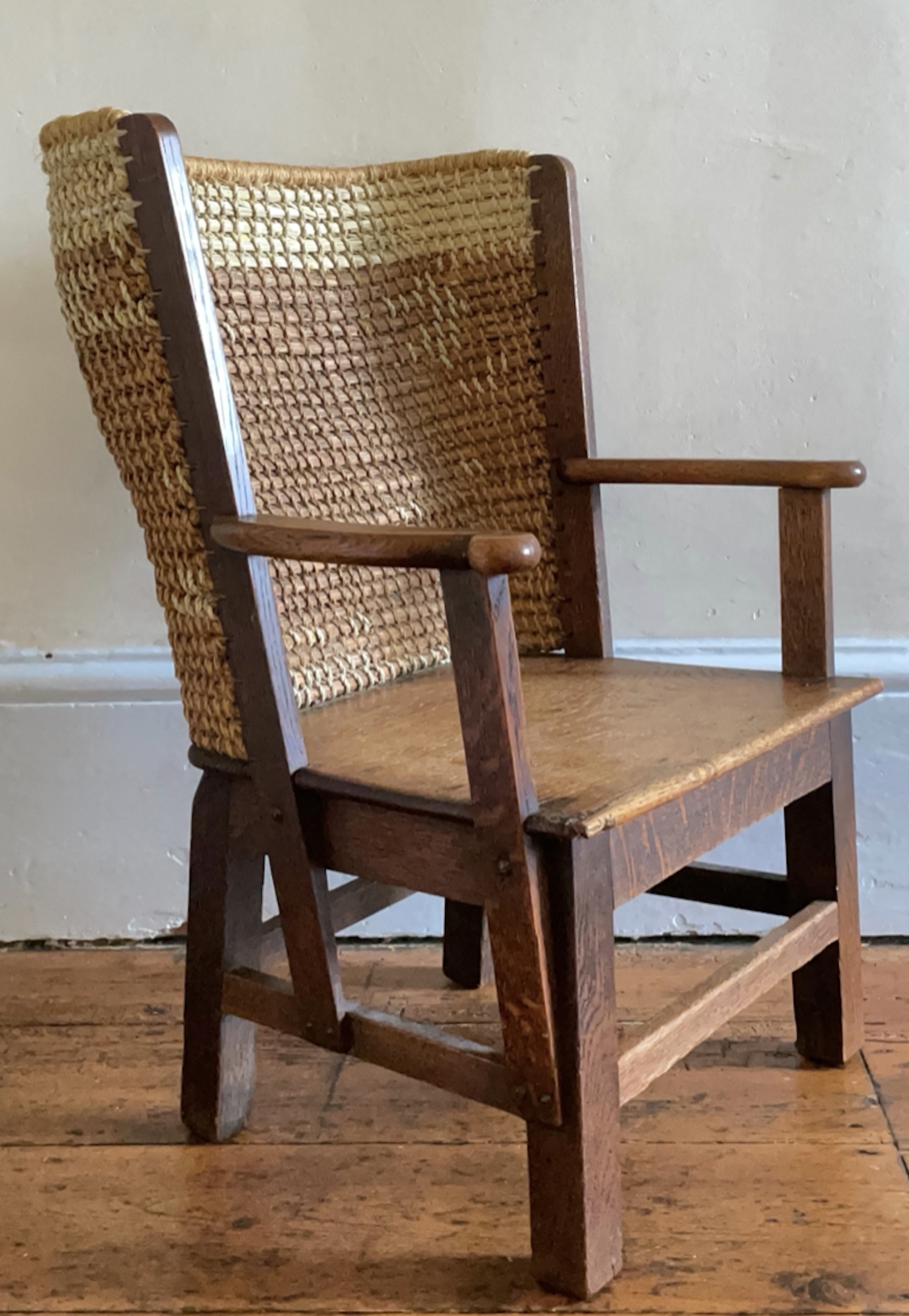
Occasionally I undertake basket and chair seating repairs. Doing such work is difficult to quote for and I known that I underestimate my own expertise.
It was a privilege to fulfil an over a half a life time’s dream to restore an Orkney chair. The client and I made the decision to show all the repair work on this child’s chair for which I used Orkney grown black oat straw and made marram grass cordage. Like visible darning on an old well loved hand-me-down jumper, every new stitch reveals little lives lived.
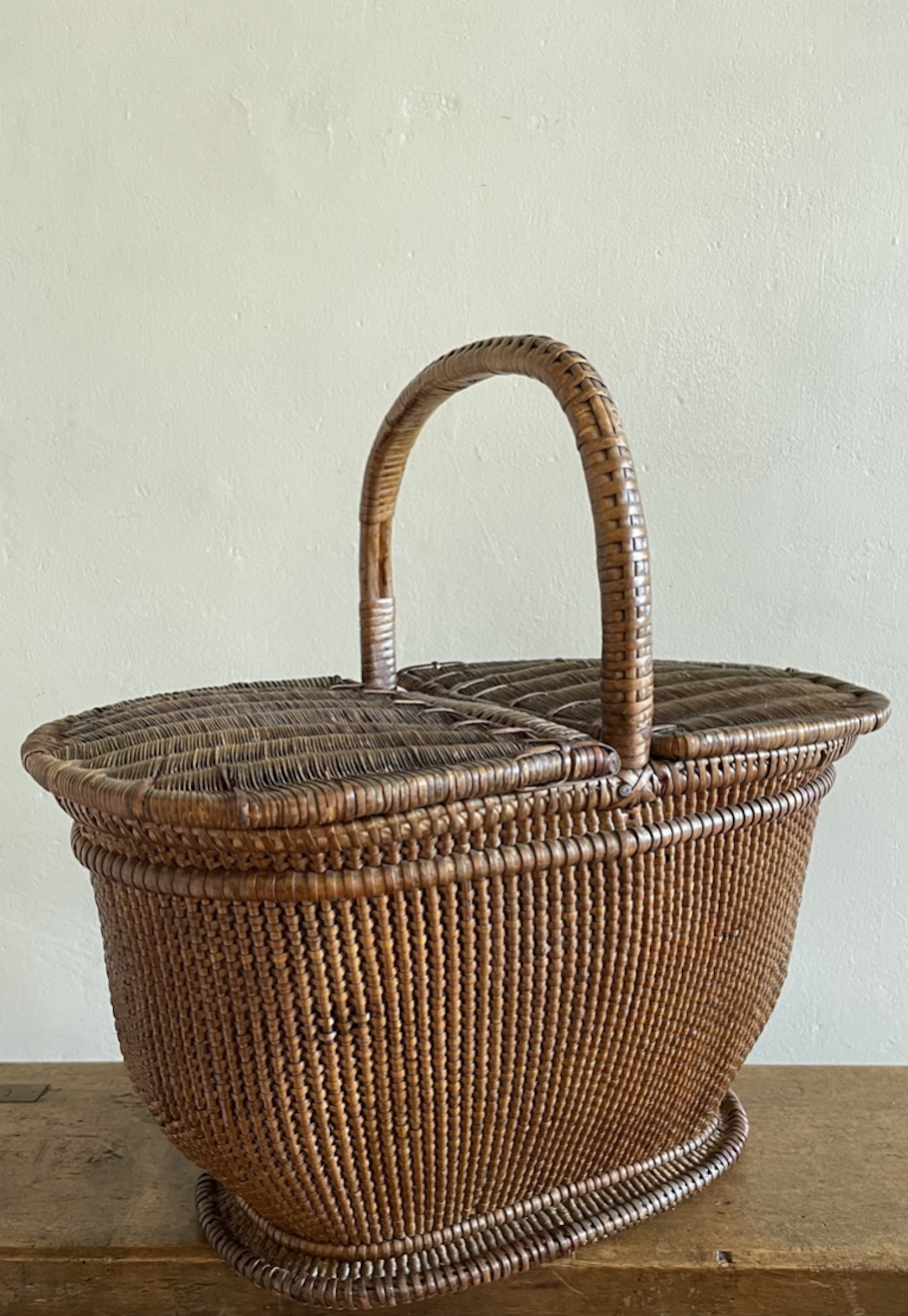
This most beautiful and very fragile willow basket, sent to me from the USA was an amazing and somewhat terrifying challenge to clean, mend, conserve, and do an invisible repair on whilst keeping for the client the baskets’ character. This fine skein work basket, most likely made in the Low Countries in Europe could date back hundreds of years. (Examples of this type of fine basketry can be seen in paintings from the late medieval period onwards). A stunning rich patina, which on closer inspection revealed was created by at sometime during its long life a varnish having been applied. On the plus side the varnish had acted as a glue and given this very fragile basket a whole new lease of life, but it also made it much harder for me to conserve and repair.
I rebuilt a lid, reattach both lids, mended broken or missing 3mm wide skeins on the basket sides and so to increase the baskets future longevity, I created new skein work all around the base rim. With all the repair work done, but visible, I worked with multiple shades of wood dye, painted the new willow, often layering several coats of dye to achieve the colour and depth required. My subsequent understanding, ability and confidence with skein work fine basketry, all deepened by undertaking this repair, highlighted to me the type of basketry and chair seating that I wish to in the future excel at.
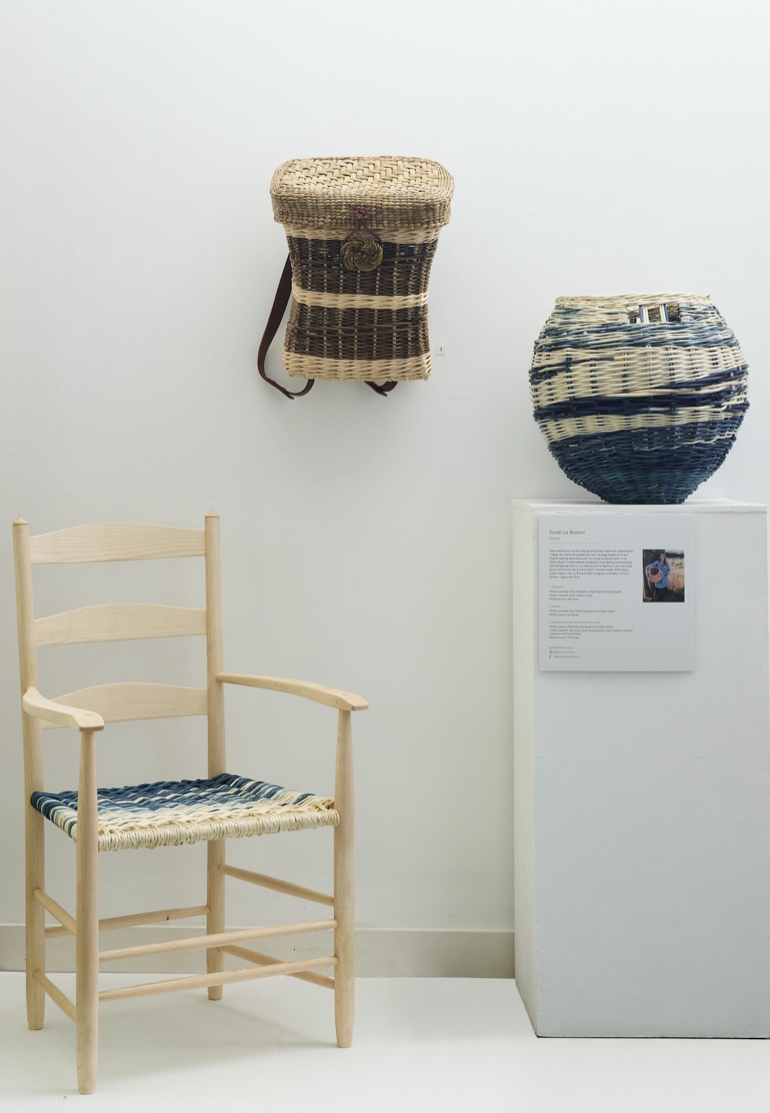
The Nourish Exhibition in 2022 at the Crafts Study Centre, in Surrey was the first time that I exhibited my work. As 1 of 16 UK wide makers, all of us working in willow, following taking part in a CPD business programme led by Cockpit Arts in 2021, us makers decided that the best way to up our profiles and prices was to create our own exhibition. Being a lead organiser was a lot of work but we gained funding, a very good venue, brilliant curatorship and recognition.

In 2024 - 25 the UK wide touring Exhibition Basketry: Rescuing, Reviving, Retaining showcased 2 of my Ose baskets. To have my work exhibited alongside the UK’s top makers was incredible!
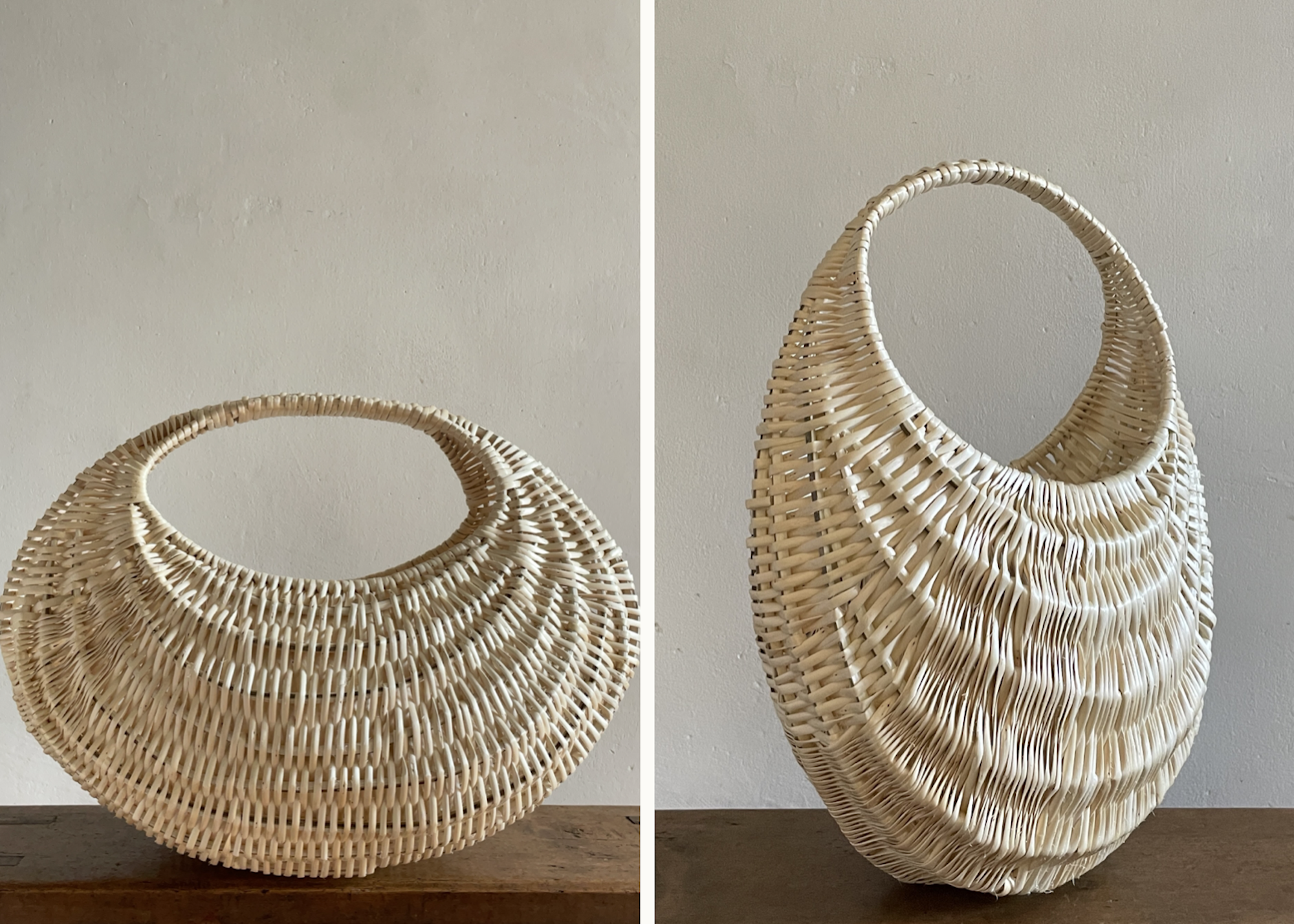
I will often study traditional heritage baskets in museum collections, make a replica and then create my own contemporary version that retains the knowledge, techniques and skill set. My replica Skye Ose basket, (seen lower right), was exhibited alongside my contemporary Ose basket (beside on left). The Ose basket, known by many names including the Hen, Gondola or Brigitte Bardot basket, has been documented in various sizes across Europe since Medieval times. During this time the Ose shifted from a stone mason’s rubble basket, to poultry basket to shopping basket to iconic fashion accessory.
I have become known for my Ose baskets and taking the now endangered basketry technique of skein work forward into new sculptural forms. By taking a white willow rod and splitting, cleaving and shaving the wood into fine ribbons, known as skeins, the willow can then be wrapped and layered into textured ripples that catch the light. My Pod and Ripple Ose baskets are currently being exhibited at the MAKE Southwest Member Exhibition.
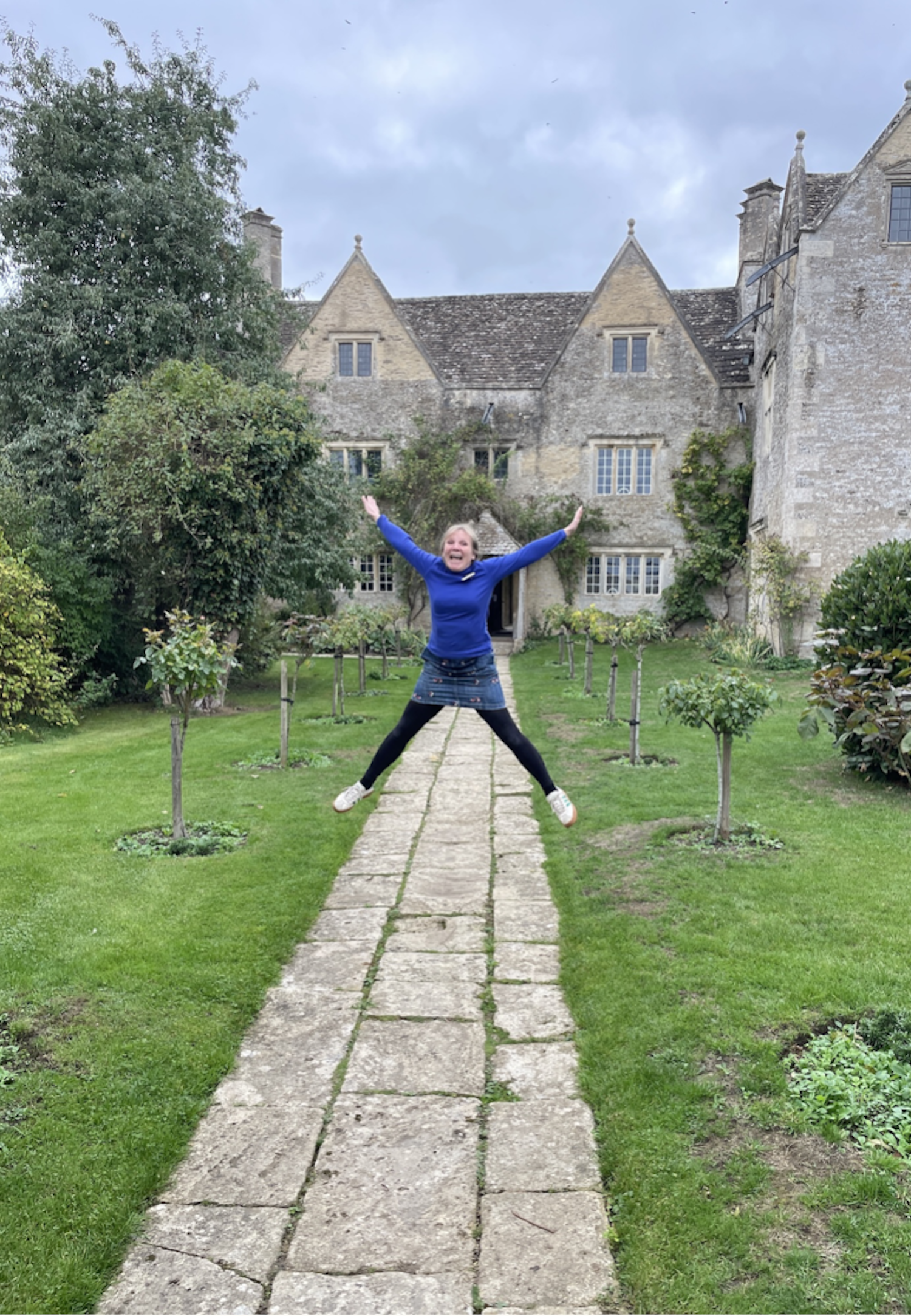
And now finally to Kelmscott Manor! My residency this year has fulfilled everything I’ve hoped it could be. Being awarded this residency was, as you’ve probably gathered, much needed and very timely. It’s no exaggeration to say that it’s confirming my purpose, my existence; giving me the strength to keep fighting for what I believe in.
Within a world that I have often felt out of time in, we, (that’s both the manor and myself), stand I think in fragile defiance, and we (that’s again both the manor and myself!) have taken on an incredible gift, to not only be rejuvenated but also help to rejuvenate, energise and transform those who we meet.
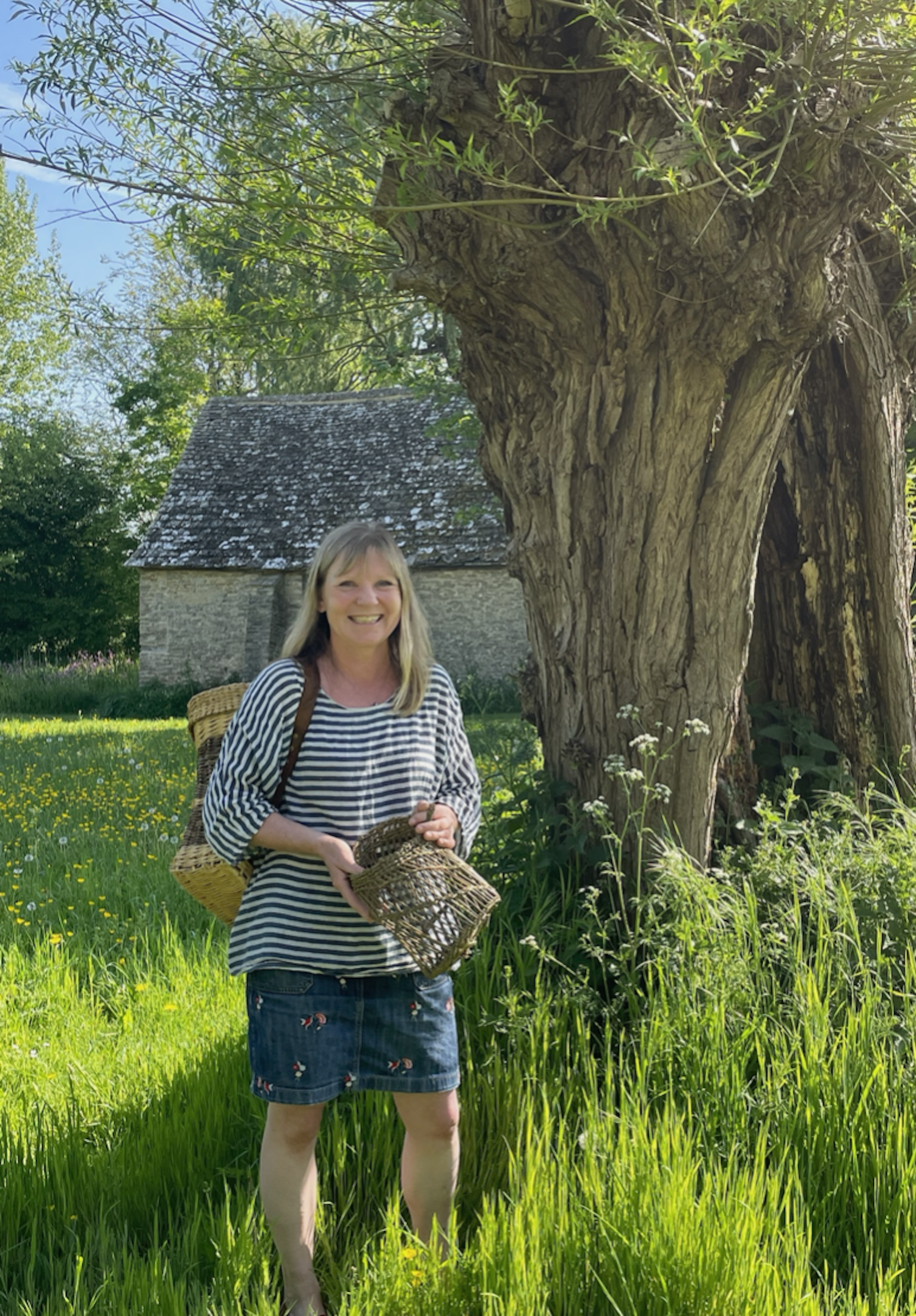
Feeling so at home within the house and the grounds, the residency has gifted me moments to enable inspiration to flood in. By being close to cherished objects, including experimental works by Morris, by spending time within their craft, I’ve learnt to explore more, to play, to dream again. I’m beginning to believe again that obstinate determination and hard graft can achieve great things.
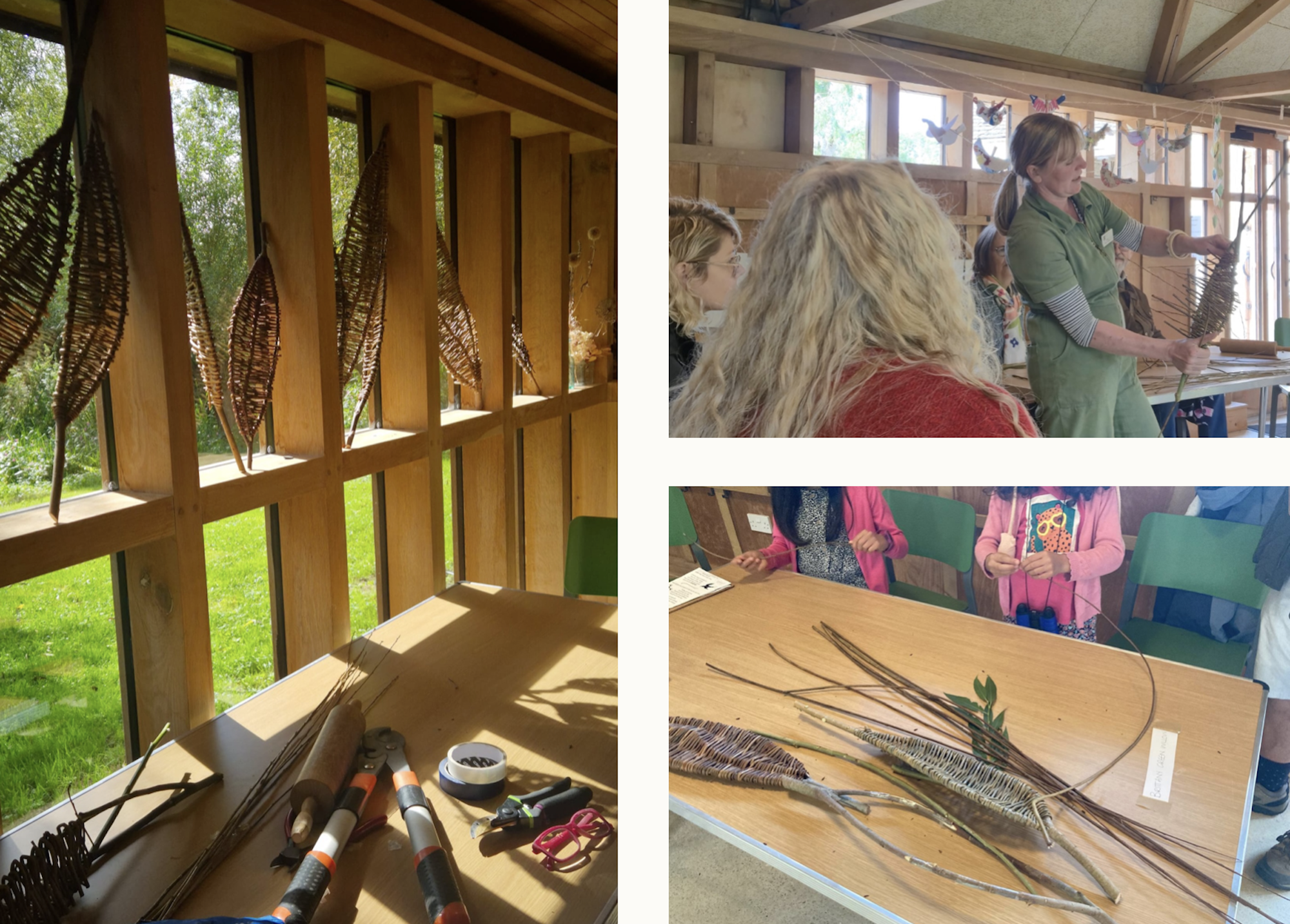
Leading a series of drop in sculptural willow leaf workshops has shown me the joy again of being able to teach both the young and those who would never think of attending basketmaking workshops. To imbue the qualities of willow and the act of weaving to everyone at Kelmscott is so wonderful. These 50 or so leaves will be installed as a community sculpture along the yard wall opposite the learning barn for the 2026 season.
From the very beginning of my residency I wanted to create a sculptural piece with the visitors that enhanced their journey and experience of Kelmscott, not only as they moved physically through the grounds but enabled them to glimpse and explore the rooting and transformative power of willow weaving.
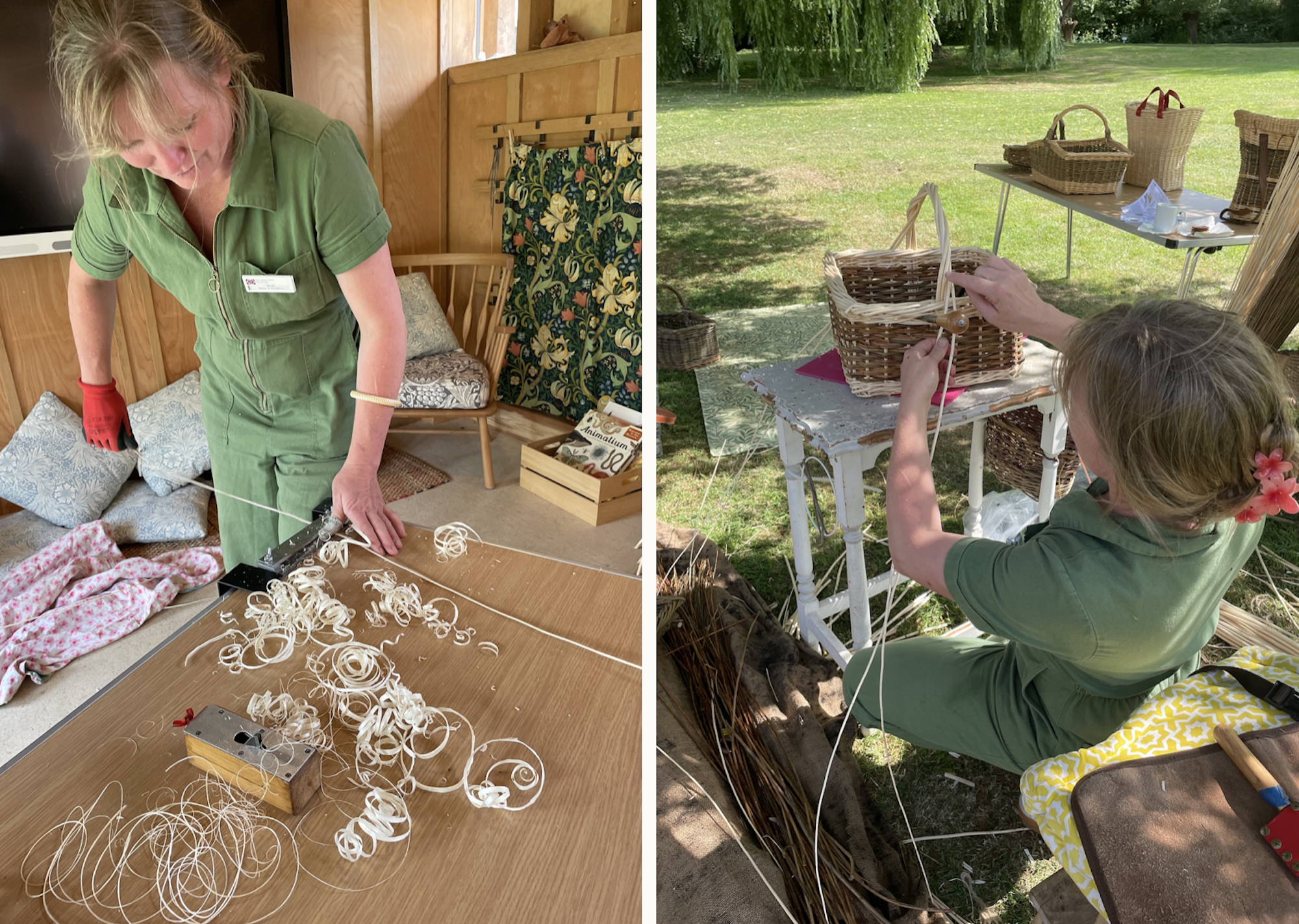
Over four demonstrations I’ve been able to show the crafting of natural materials and explain the importance of reviving endangered basketry skills and techniques. From demonstrating skein work making to creating traditional English willow Oval and Square work baskets to rush seating a Liberty’s chair.
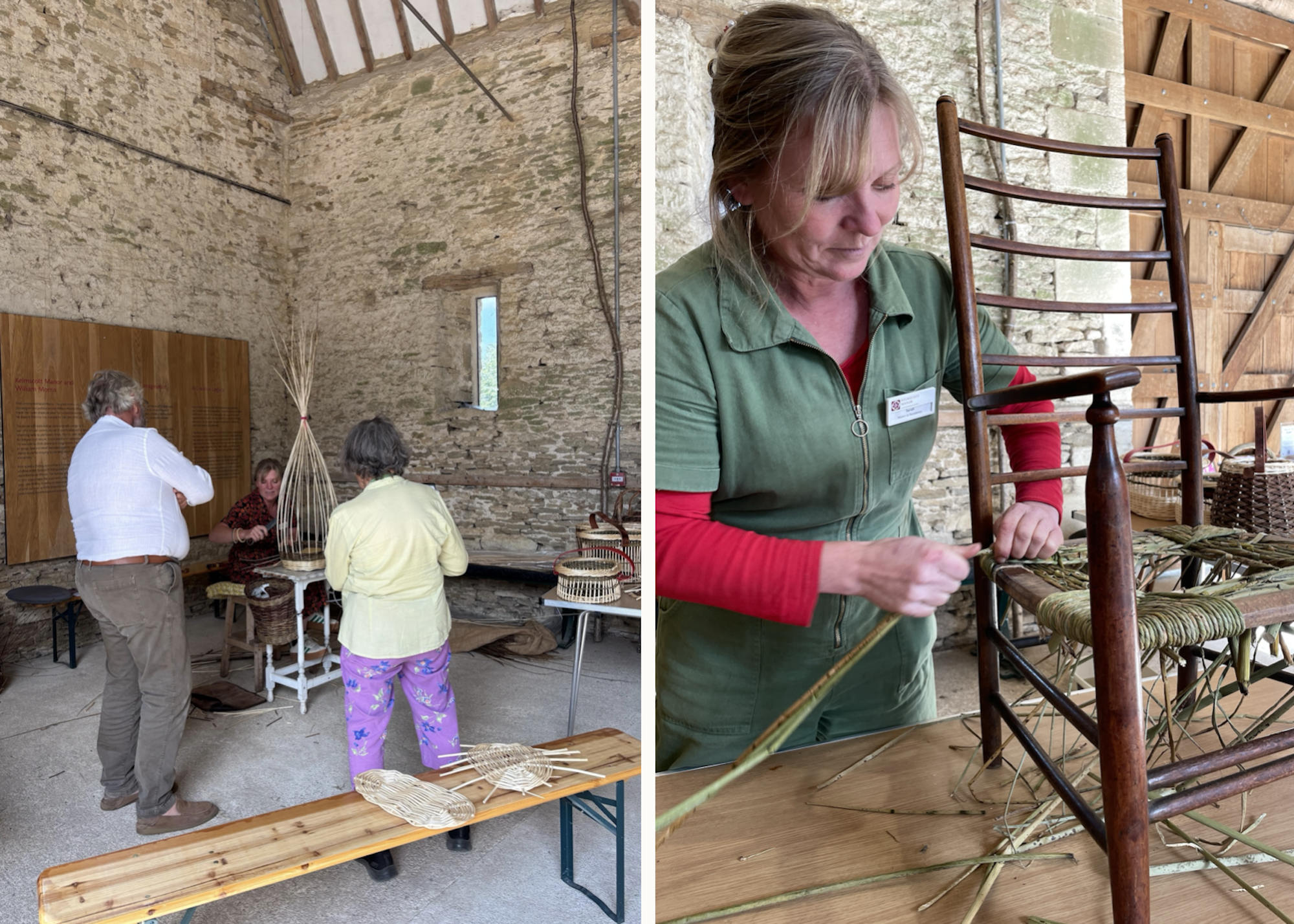
Prior to the residency I already felt that so many of William Morris’ ideas and values are held within what I create each day, in what I strive to make, to achieve, (for both myself and my craft form), in how, what and why I teach, and in how I live… but now I KNOW this is the case.
Responding to my time at Kelmscott I have developed a Morris Inspired Basket Collection that showcases our willow basketry heritage, and that will be exclusively sold at the manor and through my website. Each basket is designed and handcrafted by myself; aims to both revive traditional English basketry techniques and be created for the way we live today. Each basket is inspired by the Morris family and their home and encapsulates the ethos of the Arts & Crafts movement.
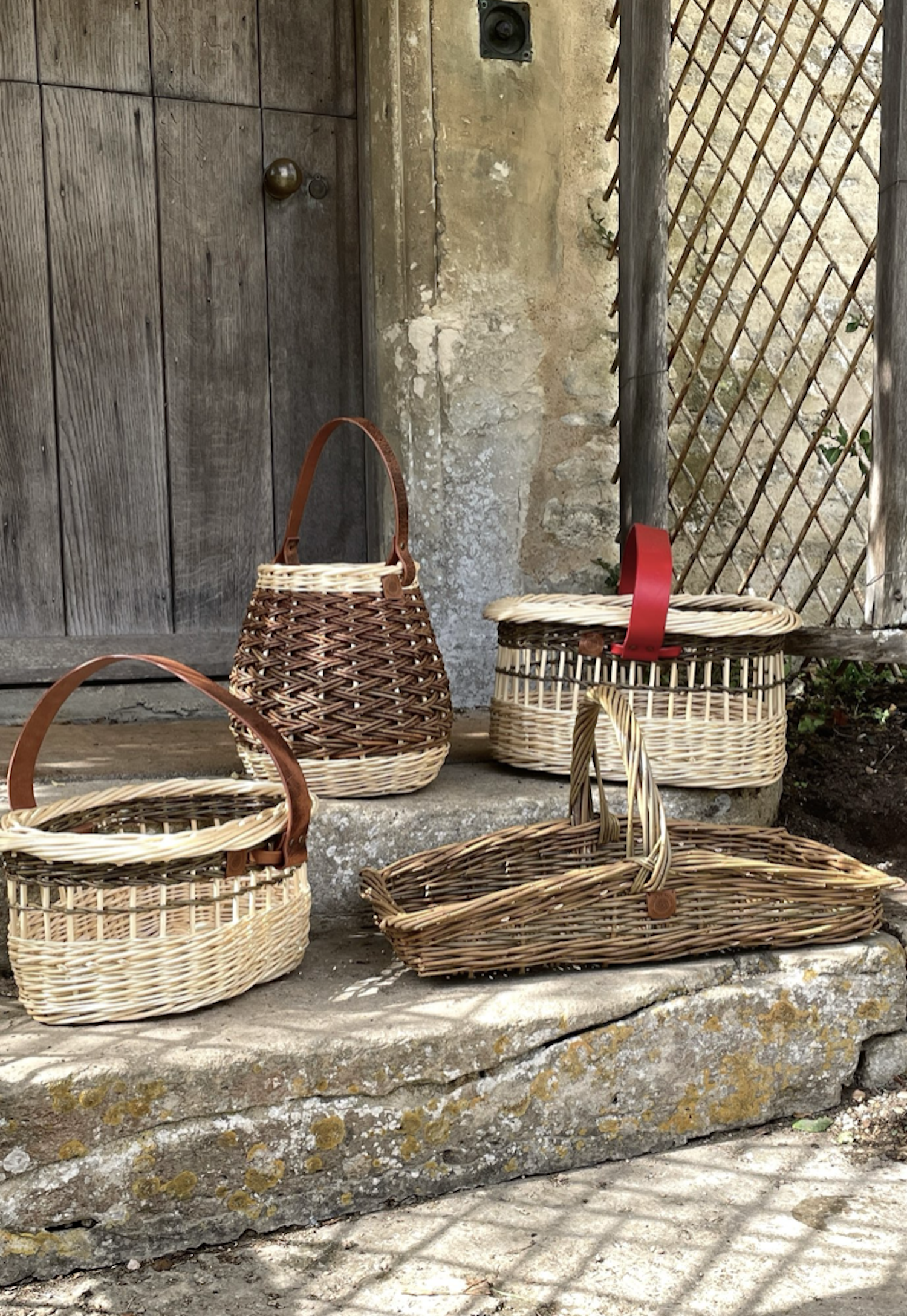
I’ve created the oval basket, (top right and bottom left,) to be the essential basket that you need in your life! Perfect for shopping, storing belongings and to have on display in your home. The basket highlights the beauty of highly prized Somerset sourced natural white willow. Showcasing the rare traditional English oval underfoot tied slath base as well as the advanced fitched basketry technique which gives a modern open feel, this basket is completed with a distinctive broad border and a wide bold leather handle.
The Meadow ‘B’ Basket, (top left), is my latest interpretation of a traditional English Berry basket, with an elaborate herringbone side weave inspired by the bark pattern on the mesmerising old willow tree in the meadow. I’ve deliberately created this basket to promote a variety of willow, Harrison’s B, that has just been brought into commercial growing production on the Somerset Levels.
Inspired by spending my time in the gardens at Kelmscott Manor and also in tribute to May Morris, the Flower Basket, (bottom right), is my interpretation of a traditional willow trug that is enhanced by a contemporary weave and colourful willow varieties. (Yes William Morris has even taught me how to become a better sales person!)
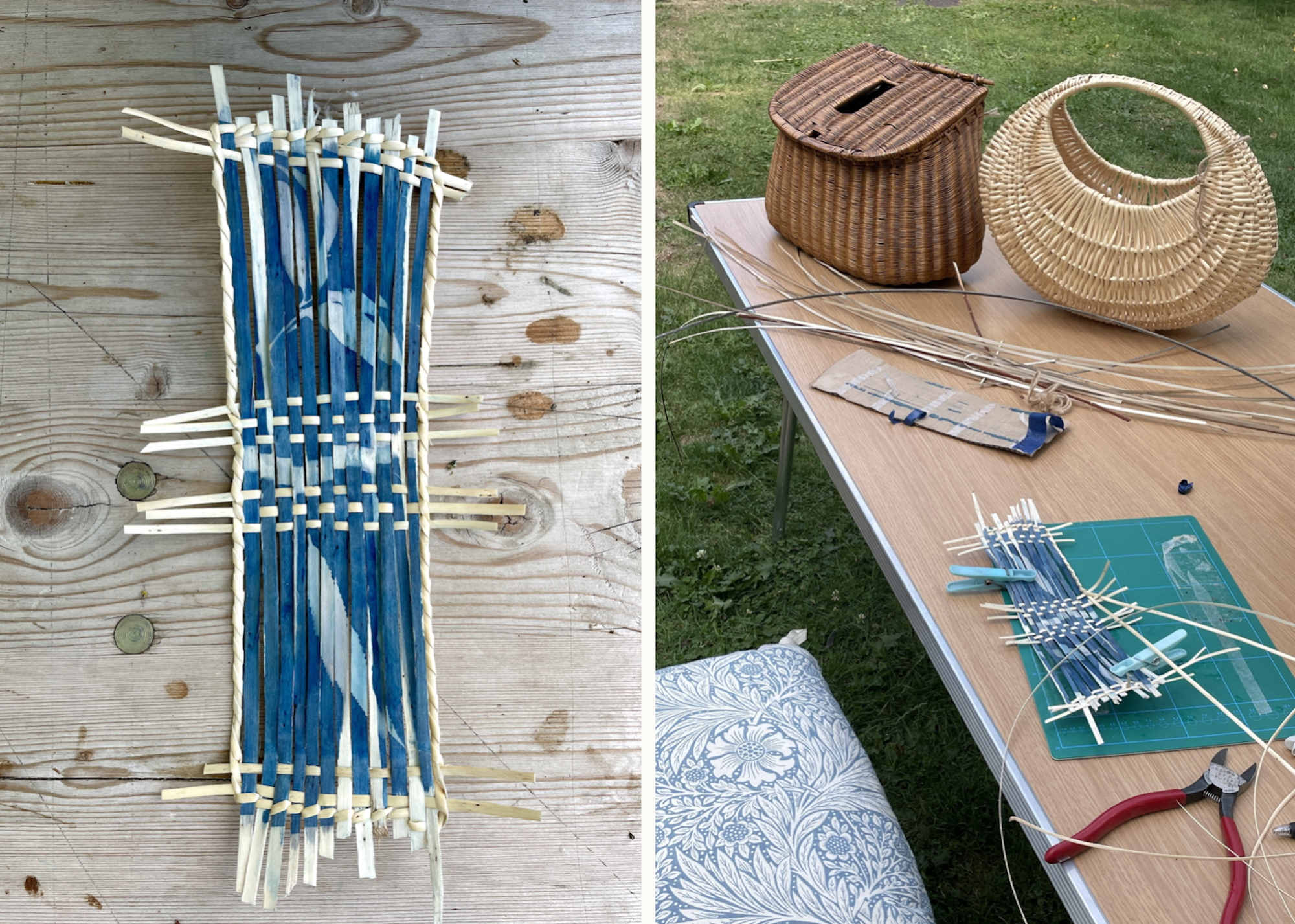
Being at the manor has ignited amazing conversations with staff, volunteers and visitors that have led to much research, exciting, ever opening pathways and a deepening understanding of my work and myself.
I am currently creating my physical asset to be retained by the Society of Antiquaries and Kelmscott Manor. This basketry piece will represent my time at the manor and be a culmination of my exploration, rejuvenation and inspiration. (For example I’ve finally had the chance to experiment with cyanotype printing on willow). I’m currently pushing myself to create a piece of work using an advanced skein work basketry method that as far as I’m aware has not been undertaken in the UK in over a hundred years. I do this to forward our knowledge of my craft form, to prove my ability to myself and hopefully to inspire the present and next generation of willow weavers.
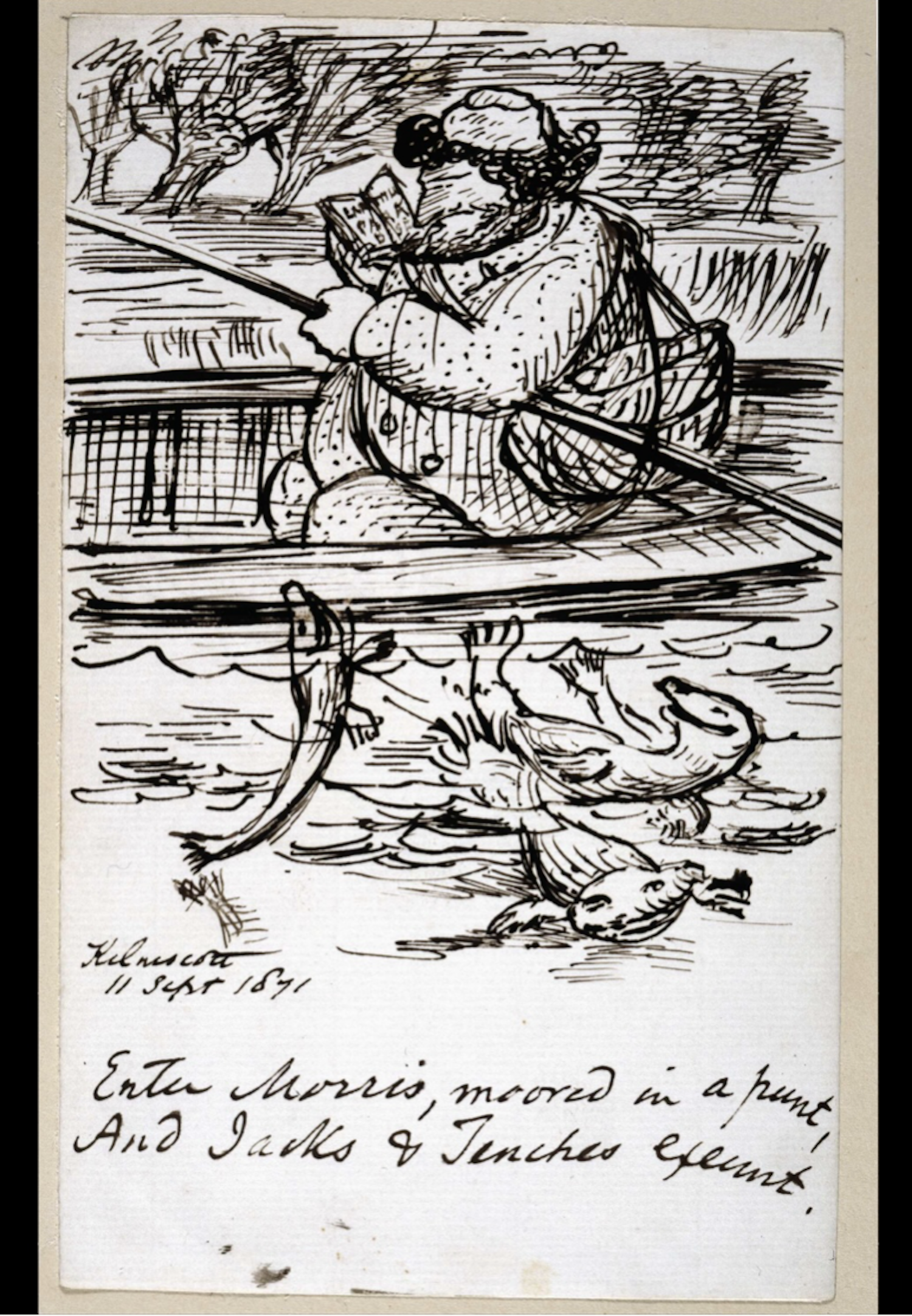
Morris loved fishing on the Thames river that flows just in front of the manor. Rossetti’s ink drawing of September 1871, now residing in the British museum, caricatures Morris sitting with a fishing rod under his arm, too engrossed in reading his newly published poem The Earthly Paradise to notice fishes leaping gleefully around his boat. Slung over Morris’ shoulder is a fishing creel, most likely made of willow, one that I am imagining back into being.

My physical asset is an interpretation of Morris’ creel, showcasing skein work in a more contemporary form. So far it’s taken me many hours of repeatedly experimenting with the construction, with laboriously making the willow skeins, with getting to grips with the nuances of the weaving on a new form. There are no written instructions or diagrams detailing how to create such a basket. As far as I’m aware there are no craftspeople alive who use this method that I can learn from. But beside me as I make I have a copy of one ink drawing, a French antique skein work fishing creel to examine and marvel at and I’ve got Morris to inspire me.
*William Morris - The Decorative Arts: their relation to modern life and progress. 1877 lecture. https://www.marxists.org/archive/morris/works/1877/decorative.htm